So What Does "Current Policy" Look Like?
Here at CRFB, we love constructing baselines. Whenever CBO constructs its own budget baseline, in fact, we rush to adjust it. CBO's projections, as our readers know, are constrained by a combination of "current law" (they can't assume legislative action, even when there is a near certainty it will occur) and budget convention.
We, of course, face no such constraint. And so we use a combination of CBO cost-estimates and our own calculations to determine what the deficit would be if we -- as a country -- continued on our current path, and as our readers know, the answer isn't pretty. But whereas there is only one definition of "current law," for the sake of budgeting, many of us disagree on just what "current policy" includes.
Today, CBO released projections of one such scenario, as requested by Paul Ryan. Since Congressman Ryan was aiming to show how much taxes would need to increase if we were to balance the budget from that side of the ledger alone (the answer: a lot), he focused on tax assumptions. Specifically, he asked CBO to assume that the 2001/2003 tax cuts scheduled to expire on December 31st are continued permanantly. He also asked CBO to assume policymakers continue to impliment regular "patches" for the Alternative Minimum Tax (AMT), and to assume funding for Iraq and Afghanistan at the levels outlined in the President's budget.
As a result of these assumptions, deficits over the next decade would equal $9.4 trillion, instead of $6 trillion under CBO's current law baseline (FY2011-FY2020). And 5.3% of GDP in 2020, as opposed to 3% of GDP.
Yet as bad as that situation is, the reality is probably worse. About a month ago, we constructed our own current policy baseline. In addition to Ryan's assumptions (and somewhat different Iraq assumptions), our baseline assumed that policy makers would continue to update Medicare physician payments -- as they always have -- and that discretionary spending will grow at the same rate as the economy, rather than the rate of inflation.
Under that scenario, deficits would be $12.4 trillion (rather than $6 trillion) over the next decade, and nearly 7.8% of GDP (rather than 3%) in 2020. Even under an alternative "reasonable policy baseline," in which tax cuts for families making over $250,000 are allowed to expire, we calculate cumulative deficits of $11.6 trillion over ten years, and 7.2% of GDP in 2020.
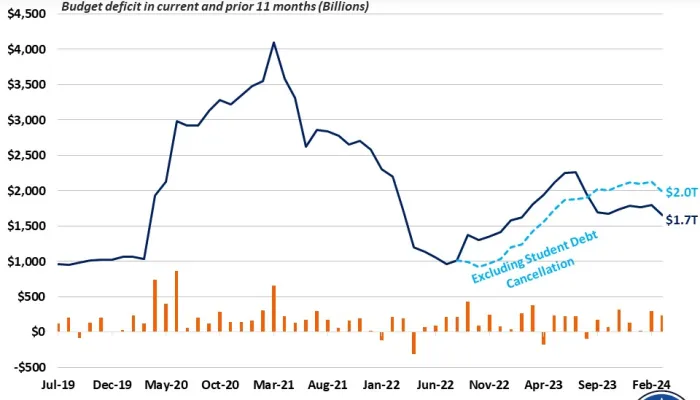
Other organizations (including the OMB) have come to different conclusions, depending on what policy assumptions they make. We have graphed many of these baselines as a percent of GDP (based on CBO's GDP estimates) here:
Although the projections may vary, the message is the same. Continuing current law levels of borrowing would be bad. Continue current policy would be devastating.
We need to reverse course.